Introduction
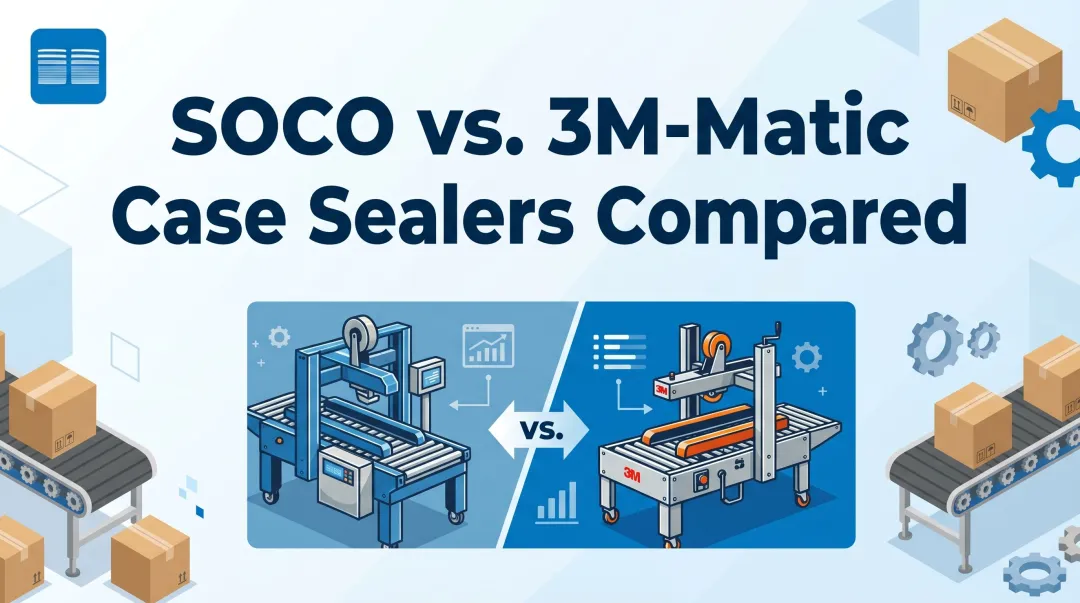
When your case erector goes down, the entire line stops. For Midwest packaging managers choosing between the two, SOCO and Wexxar consistently top the shortlist — and both have earned strong reliability reputations through different engineering approaches.
Asking "which holds up better" is the right question. The answer depends on how you define durability — because purchase price tells only part of the story.
The machines that truly hold up match your production environment, minimize unplanned downtime, and keep maintenance costs predictable over 10+ years. Build quality, parts availability, and service response matter just as much as the nameplate.
Key Takeaways
- SOCO case erectors use vacuum suction systems and touchscreen controls, built for gentle box handling in food, beverage, and pharma environments
- Wexxar machines rely on hardened steel Pin & Dome mechanics optimized for high-volume warehousing and distribution workloads
- Both are durable — the right choice depends on your industry, throughput volume, and in-house maintenance capabilities
- Drive system design, changeover speed, and parts availability are the deciding factors in this comparison
- John Maye Company is the Midwest's authorized SOCO distributor, offering factory-certified service and a 24-hour shipping guarantee
SOCO vs. Wexxar: Quick Comparison
Build & Drive System
SOCO case erectors use Siemens PLC controls, Festo pneumatics, and vacuum suction systems for precise box handling. This combination delivers repeatable motion control and reduces mechanical wear on corrugated materials—particularly important for fragile packaging or premium graphics. The vacuum-based pickup system grips boxes gently, minimizing damage during erection.
Wexxar's patented Pin & Dome mechanical system uses hardened steel components to erect cases through direct mechanical contact. This simple, robust architecture eliminates vacuum cups and their associated wear points. According to Wexxar, their mechanical design is "maintenance-free" compared to pneumatic alternatives, reducing routine service intervals.
One critical distinction: while SOCO uses pneumatic power for actuation, Wexxar has increasingly integrated servo drives into their lineup. Wexxar's own technical documentation notes that servo systems deliver 85%+ efficiency versus just 10% for traditional pneumatics, with 40% SCFM savings in compressed air consumption.
Speed & Throughput
SOCO production speeds:
- Fully automatic models: 8-18 CPM (BE-2500 ATS at 8 CPM; BE-2200 ATS at 18 CPM)
- Hot melt configurations: 10-12 CPM
- Semi-automatic: operator-paced
Wexxar production speeds:
- Fully automatic: 15-30 CPM (BEL 625 and WF30 at 30 CPM)
- Semi-automatic BEL 505: 15 CPM
Rated speed matters less than actual throughput when changeovers are frequent. A 30 CPM machine that requires 15 minutes of manual adjustment between SKUs may deliver lower daily output than an 18 CPM machine with sub-minute changeovers.
Changeover & Flexibility
SOCO uses spindle adjustments, interchangeable suction plates, and touchscreen software to accommodate different box sizes. Changeover time depends on the specific model and size range, but the system prioritizes precision over raw speed.
Wexxar's tool-less changeover system requires under 7 minutes for standard adjustments. Their advanced Auto Adjust option (available on models like the BEL 625) uses SIKO positioning drives to deliver one-button changeover in under 30 seconds. The system includes color-coded components and pictorial guides to reduce operator error.
For high-mix environments running 5+ SKUs per shift, Wexxar's Auto Adjust provides a clear labor advantage.
Maintenance Profile & Parts
SOCO maintenance characteristics:
- Uses standard industrial components (Siemens, Festo, Nordson) with broad availability
- "Long service life" with spare parts supported through equipment lifetime
- No published MTBF (mean time between failure) data
Wexxar maintenance characteristics:
- 99% uptime claimed for BEL 625 model
- Pin & Dome system eliminates vacuum cup replacement
- WISE diagnostic system with Dozuki digital maintenance platform
- 12-month warranty standard
- Parts lead times: 4-14+ weeks for specialized components
Neither manufacturer publishes detailed MTBF statistics, making independent verification difficult. Wexxar's FAQ claims machines remain in operation 30+ years with proper maintenance—an extraordinary lifespan for packaging equipment.
Parts availability becomes the deciding factor when a line goes down. John Maye Company stocks 2,500+ SKUs at their Waukesha, Wisconsin headquarters and ships in-stock SOCO parts within 24 hours—turning a potential multi-day shutdown into a same-day fix.
Price Point & TCO
Neither brand publishes list pricing. Based on distributor quotes and buyer reports, SOCO typically comes in at the higher end of the market; Wexxar sits in the mid-to-upper range.
That gap narrows considerably when you account for total cost of ownership over 10-15 years:
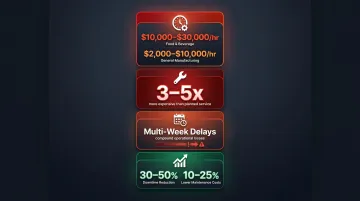
- Downtime costs: $10,000-$30,000/hour in food & beverage; $2,000-$10,000/hour in general manufacturing
- Emergency maintenance: 3-5x more expensive than planned service
- Parts lead times: Multi-week delays compound downtime losses
- Predictive maintenance ROI: 30-50% downtime reduction, 10-25% lower maintenance costs
A NOVA Automation TCO analysis recommends evaluating packaging machinery over 12-15 years with 2-year ROI expectations. A machine that costs $15,000 less upfront but adds 48 hours of downtime per year will erase that savings within the first two years of operation.
Meet the Contenders: SOCO and Wexxar Case Erectors
SOCO Case Erectors
SOCO System, founded in 1961 in Denmark, engineers precision case erecting equipment from two Danish manufacturing facilities. With approximately 170 employees and subsidiaries across six countries, SOCO established its US presence in Minnesota to serve North American operations.
Core technology advantages:
- Siemens PLC with Proface touchscreen interface for intuitive operation
- Festo pneumatic components delivering consistent actuation
- Vacuum suction that handles fragile boxes without crushing or damaging graphics
- FEFCO 0201 (RSC) standard with optional overlapping flaps
- Stainless steel construction available for food-grade and pharmaceutical environments
Key model families:
- BE-2200 through BE-2500 ATS series (fully automatic): 8–18 CPM depending on case size
- BE-2200/2300 AHS series (hot melt): 10–12 CPM
- SOCO Pack OAB (automatic bottom lock): 12 CPM
- F-100 series (semi-automatic): operator-paced with pneumatic assist
SOCO machines excel in food & beverage, pharmaceutical, and e-commerce applications where product integrity, cleanroom compatibility, and gentle handling justify premium investment. John Maye Company has served as the regional SOCO distributor in the Midwest since the 2010s, with factory-certified technicians and deep parts inventory on hand for rapid response.
Wexxar Case Erectors
Wexxar traces its roots to 1977 in Canada. After merging with Belcor in 2000 and being acquired by ProMach in 2005, the company now operates from a 100,000 sq ft facility in Richmond, BC. With 200+ employees, the brand claims 15+ major industry innovations, serves customers in 40+ countries, and reports a 50%+ repeat customer rate.
Core operational strengths:
- Pin & Dome patented mechanical system built from hardened steel for long-term durability
- WISE control platform with integrated diagnostics
- Servo-driven positioning (SIKO drives) on Auto Adjust models
- Tool-less changeover under 7 minutes; under 30 seconds with Auto Adjust
- Supports RSC and HSC (half-slotted container) formats
Key model families:
- WF30/WF20 (fully automatic): 20–30 CPM
- BEL 625 (robotic fully automatic): 30 CPM with Auto Adjust
- BEL 615 (fully automatic): 15 CPM
- BEL 505 (semi-automatic): 15 CPM
Wexxar's mechanical simplicity and robust construction suit warehousing, distribution, and general manufacturing operations running dedicated SKUs at high volume. In-house technicians can handle most maintenance without specialized training — a genuine advantage for facilities without dedicated service staff.
One caveat: manual changeover models add labor on multi-SKU lines. Operations switching formats three or more times per shift may see reduced effective throughput despite the higher rated CPM.
SOCO vs. Wexxar: Which Holds Up Better?
Framing Durability Correctly
A machine running one box size at 40 CPM for eight hours faces different wear dynamics than one changing formats three times per shift. "Holds up better" isn't about brand reputation—it's about matching machine characteristics to production reality.
Build Quality and Wear Resistance
SOCO's vacuum suction architecture eliminates many mechanical contact points. Boxes are gripped by controlled vacuum rather than pushed through cams and linkages. This reduces wear on both the machine and the corrugated material, extending component life and minimizing box damage. The tradeoff: vacuum systems require regular cup inspection and replacement.
Wexxar's Pin & Dome mechanical system uses hardened steel components engineered for millions of cycles. According to Wexxar, the system is "maintenance-free" compared to alternatives that rely on vacuum cups, timing belts, or mechanical linkages. The robust construction handles high-cycle environments without significant wear.
That said, PMMI's research on servo-axis failures notes that mechanical systems accumulate wear through repeated contact, while servo-driven systems can experience controller failures or encoder drift. The real question isn't which architecture is tougher overall — it's which failure mode your maintenance team is better equipped to handle.
Maintenance Burden Over Time
SOCO maintenance requirements:
- Routine inspection of vacuum cups and pneumatic seals
- Siemens PLC and Festo component servicing (widely supported)
- Requires technicians familiar with PLC troubleshooting
- Standard industrial components reduce parts complexity
Wexxar maintenance requirements:
- Pin & Dome system requires minimal routine service
- Servo systems (Auto Adjust models) need periodic calibration
- WISE diagnostics simplify troubleshooting for operators
- Dozuki digital platform provides step-by-step maintenance guides
- More accessible for in-house teams with basic mechanical skills
The key difference comes down to team capability. Wexxar's mechanical design lowers the skill threshold for routine maintenance, while SOCO's precision components may require more specialized knowledge — but offer fewer mechanical wear points overall.
Parts Availability and Service Response
A $200 part with a 4-week lead time can cost $50,000+ in lost production for a food plant running 24/5.
SOCO parts through John Maye Company:
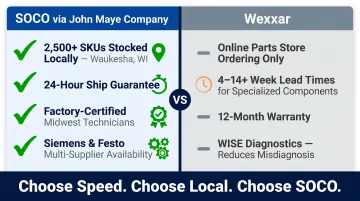
- 2,500+ SKUs stocked locally in Waukesha, Wisconsin
- 24-hour ship guarantee on in-stock items
- Factory-certified technicians available across the Midwest
- Siemens/Festo components available from multiple industrial suppliers
Wexxar parts:
- Online parts store with direct ordering
- 4-14+ week lead times for specialized components (per Wexxar FAQ)
- 12-month warranty standard
- WISE diagnostics reduce misdiagnosis and unnecessary parts orders
For Midwest operations, John Maye Company's local parts inventory eliminates the multi-week wait that turns routine maintenance into unplanned downtime. That inventory advantage is particularly relevant for food and pharmaceutical lines where unplanned stoppages carry compliance and spoilage costs beyond the production loss itself.
Situational Recommendations
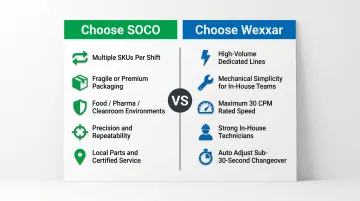
Choose SOCO if you:
- Run multiple SKUs per shift requiring frequent changeovers
- Handle fragile or premium packaging where gentle handling prevents damage
- Operate in food & beverage, pharmaceutical, or cleanroom environments
- Value precision and repeatability over raw speed
- Have access to local parts inventory and factory-certified service (like John Maye Company in the Midwest)
Choose Wexxar if you:
- Run dedicated high-volume lines with infrequent format changes
- Prioritize mechanical simplicity for in-house maintenance teams
- Need maximum rated speed (30 CPM) for consistent formats
- Have strong in-house technician capabilities and can manage longer parts lead times
- Value the Auto Adjust system for sub-30-second changeovers (BEL 625)
Real-World Considerations: Making the Right Call for Your Line
A Midwest food manufacturer running mixed SKUs on a single packaging line experienced repeated unplanned downtime due to changeover errors and mechanical drift. With five different case sizes cycling through daily production, manual adjustments consumed 45-60 minutes per shift. Quality rejects from improperly erected cases added another layer of waste.
The operation evaluated both platforms based on:
- Changeover frequency: 5+ SKU changes per day
- Maintenance resources: Two in-house techs with basic mechanical training
- Service proximity: 90-minute drive from distributor
- Capital budget: Mid-range investment with 18-month ROI target
While published case studies specific to SOCO or Wexxar weren't available, a Packaging World case study from Radwell International documented 300% productivity increase after implementing automated case erecting for six case sizes on-demand with zero changeover time. The operation eliminated manual setup errors and increased throughput despite similar rated speeds.
Those results reflect a pattern that held for the Midwest manufacturer as well. Access to John Maye Company's 24-hour parts shipping and on-site SOCO service technicians became the deciding factor. The precision vacuum system reduced case damage by an estimated 15-20%, and touchscreen changeover simplified operator training across shifts.
The right machine isn't determined by spec sheets alone. Production environment, format flexibility, service proximity, and parts availability all shape what a case erector actually costs over time. John Maye Company offers equipment consultations to help evaluate which platform fits your specific line requirements.
Conclusion
Both SOCO and Wexxar manufacture proven, durable case erectors—the better choice comes down to production environment, format flexibility needs, and available maintenance resources, not brand name.
The right case erector reduces unplanned downtime, lowers long-term service costs, and keeps throughput consistent. But equipment alone doesn't guarantee results. The distributor behind the machine matters just as much:
- Local parts inventory that ships within 24 hours
- Factory-certified technicians for accurate diagnostics
- Regional service response that doesn't wait on national scheduling
That's where John Maye Company fits in. Serving Midwest operations since 1983, they bring over 40 years of packaging expertise, local parts inventory, and manufacturer-trained technicians to every SOCO evaluation and installation. Contact them at 1-800-441-6293 or info@johnmayecompany.com for a side-by-side assessment tailored to your production reality.
Frequently Asked Questions
What is the main difference between SOCO and Wexxar case erectors?
SOCO uses vacuum suction systems with Siemens PLC controls for precision and gentle box handling, while Wexxar relies on a patented Pin & Dome mechanical system valued for robustness and simplicity. They're best suited to different production profiles: SOCO for fragile packaging and cleanroom environments, Wexxar for high-volume warehousing.
Which case erector brand is easier to maintain?
Wexxar's mechanical design is more accessible for in-house technicians, backed by WISE diagnostics and Dozuki digital guides. SOCO requires PLC-trained technicians but uses widely available Siemens and Festo components with fewer mechanical wear points long-term.
How fast can SOCO and Wexxar case erectors run?
SOCO fully automatic models run 8-18 CPM; Wexxar fully automatic models run 15-30 CPM. Rated speed matters less than actual uptime—a faster machine with slow changeovers can trail a slower one with sub-minute format switches.
Which case erector is better for high-mix, low-volume production?
Both handle multiple formats: Wexxar's BEL 625 Auto Adjust changes over in under 30 seconds via one-button SIKO positioning, giving it the speed edge. SOCO is the better fit when format flexibility and gentle handling carry equal weight.
What is the typical lifespan of a case erector?
Well-maintained machines from either brand typically last 10-15+ years, with Wexxar citing units still running after 30+ years. Lifespan hinges on preventive maintenance, parts quality, and correct application match from day one.
How do I choose between SOCO and Wexxar for my packaging line?
Evaluate changeover frequency, in-house maintenance capabilities, regional service support, and long-term parts availability. If you're in the Midwest, consult a specialized distributor like John Maye Company for a side-by-side assessment—local parts inventory and factory-certified service often matter more than spec-sheet differences.