Introduction
When a facility needs to upgrade or spec a new conveyor system, Omni Metalcraft and Hytrol are two names that regularly appear on shortlists—both are US-based manufacturers with broad product lines, and choosing between them without a clear spec comparison can stall procurement decisions.
The wrong choice affects more than just price. Mismatched specs translate directly to load capacity failures, wrong frame material for the environment, inadequate widths for product size, and lead times that don't align with project schedules. Manufacturing downtime costs facilities between $10,000 and $260,000 per hour when conveyor breakdowns halt production—which means getting the specification right at procurement isn't a formality, it's a financial decision.
What follows is a spec-by-spec breakdown of both manufacturers—covering load limits, widths, frame materials, industry fit, and where each system falls short—so procurement teams can make a defensible decision before issuing a PO.
Key Takeaways
- Omni Metalcraft (Michigan) leads in heavy-load capacity, wide beds (up to 108"), and automotive-grade configurations
- Hytrol is the largest US conveyor manufacturer by volume, with 150+ integration partners and deep e-commerce fulfillment presence
- At the 1.9" roller tier—the most commonly ordered size—Omni's 269 lbs/roller rating beats Hytrol's 19GSR (210 lbs/roller) by 28%
- Pick Omni for heavier loads, wider beds, or industrial/automotive applications
- Pick Hytrol for fulfillment-proven systems, wide parts availability, and established distributor support
Omni Metalcraft vs. Hytrol: Quick Spec Comparison
Use the table below to compare both brands across the specs that matter most for load capacity, frame sizing, and configuration flexibility.
| Specification | Omni Metalcraft | Hytrol | Key Difference |
|---|---|---|---|
| Roller Diameter Range | 1.4", 1.9", 2.5", 2-9/16" (up to 4" for extreme-duty) | 1-3/8" to 2-5/8" | Omni extends further on the heavy-duty end |
| Standard Frame Widths | 12"–51" (bolt-together) 6"–108" (welded) |
12", 15", 18", 24" (light-duty) 13"–55" (heavy-duty) |
Omni covers wider beds for oversized loads |
| Load Capacity (1.9" roller) | 269 lbs/roller | 210 lbs/roller (19GSR) 250 lbs/roller (199SR) |
Omni delivers 28% higher capacity at most common size |
| Load Capacity (Heavy-Duty) | 645 lbs/roller (2.5" & 2-9/16") | 630 lbs/roller (25SR/26SR) | Comparable heavy-duty performance |
| Frame Material Options | Galvanized steel, aluminum, powder-coated steel, stainless steel (rollers) | 12 ga steel, 1/8" heat-treated aluminum | Both offer corrosion-resistant options |
| Configuration Options | Straight, curve, spur, flowrail, skatewheel, ball transfer | Straight, curved, spur, expandable | Omni offers more specialty configurations |
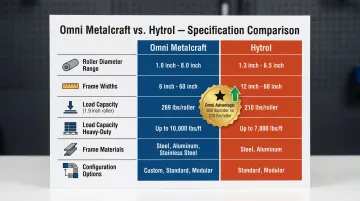
Capacity Rating Note: Omni rates capacity per roller; Hytrol publishes both per-roller and per-linear-foot ratings at 5' centers. Confirm the minimum number of rollers under load before finalizing system capacity calculations.
What Is Omni Metalcraft?
Omni Metalcraft Corp. is a Michigan-based conveyor manufacturer with over 40 years of manufacturing experience, producing gravity and powered conveyor systems from its Alpena, Michigan facility. The company serves OEMs, distributors, and systems integrators across packaging, processing, and material handling industries.
Core Product Strengths:
- Frame widths reach 51" in bolt-together construction and 108" in welded GRCW configurations
- 1.9" rollers rated at 269 lbs per roller — 59 lbs above the industry-standard 210 lbs
- Flowrail and spur setups available for complex, multi-directional facility layouts
- Stainless steel roller options for food-adjacent and washdown-resistant applications
When product weight per roller approaches 200–250 lbs, Omni's 1.9" rollers reduce the risk of deflection, premature wear, and line stoppages. That rated capacity often eliminates the need to upsize to 2.5" heavy-duty rollers for mid-weight loads — cutting both upfront costs and installation complexity.
Use Cases of Omni Metalcraft
Omni Metalcraft fits strongest in these applications:
- Heavy, irregularly shaped automotive parts that need wide-bed configurations and high per-roller load ratings
- Food and beverage staging where stainless steel rollers handle washdown-adjacent conditions
- Mid-to-heavy manufacturing assembly lines (150–260 lbs per roller) where light-duty systems fail prematurely
- Warehouse staging for oversized product footprints that exceed standard 24" bed widths
The global gravity conveyor market is projected to reach $825.5 million by 2035, driven by demand for flexible material handling across manufacturing and distribution. For buyers in those segments, Omni's wide range of frame sizes and load ratings means fewer compromises when standard configurations don't fit the application.
What Is Hytrol?
Hytrol Conveyor Co., founded in 1947 and headquartered in Jonesboro, Arkansas, is the largest conveyor manufacturer in North America with 1,600+ employees across two manufacturing facilities totaling nearly 1 million square feet.
Key specs at a glance:
- Standard widths: 12"–24" (light-duty), 13"–55" (heavy-duty)
- Roller sizes: 1-3/8" to 2-5/8" diameter
- Frame options: 12 ga powder-painted steel, 1/8" heat-treated aluminum
- Load ratings: 45 lbs/roller (light-duty SSR) to 630 lbs/roller (heavy-duty 26SR)
That range covers the majority of distribution and fulfillment applications where standard carton, tote, or parcel handling dominates.
Distributor Network Advantage
Those specs are backed by a broad support infrastructure. Hytrol maintains 150+ integration partners worldwide, which translates to practical benefits for buyers:
- Faster parts sourcing and shorter lead times for replacement rollers and frames
- Local technical support, especially valuable for operations running multiple shifts
- Wider installer availability across North American regions
Use Cases of Hytrol
Hytrol's strongest deployment history is in:
- Distribution centers: Standard-width systems handling cartons and totes
- E-commerce fulfillment: Proven track record with published case studies from Educational Development Corporation and LD Products
- Food processing lines: Aluminum frame options for corrosion-resistant environments
- General manufacturing: Applications where reliable parts availability and proven performance matter more than specialty configurations
Omni Metalcraft vs. Hytrol: Which Should You Choose?
The decision hinges on five operational factors:
1. Frame Width Requirements
Choose Omni if:
- Your products exceed 24" width and require beds beyond standard dimensions
- You're handling oversized loads, automotive assemblies, or wide pallets
- Welded construction up to 108" between frame is necessary
Choose Hytrol if:
- Standard carton, tote, or parcel dimensions (12"–24" widths) fit your application
- You prioritize faster quoting with standardized model numbers
- Your facility layout uses conventional width configurations
2. Per-Roller Load Capacity
Choose Omni if:
- Mid-weight loads (150–260 lbs per roller) are common in your operation
- You want to avoid upsizing to heavy-duty tiers unnecessarily
- The 28% capacity advantage at 1.9" diameter is sufficient to eliminate roller deflection risk
Choose Hytrol if:
- Your loads fall within light-to-medium duty ranges (under 210 lbs/roller)
- Proven deployment history in your industry segment is more valuable than marginal capacity gains
- You prioritize distributor network depth over maximum per-roller ratings
3. Specialty Configuration Needs
Choose Omni if:
- Your layout requires spur configurations, flowrail setups, or ball transfer tables
- Non-standard facility constraints demand custom conveyor geometry
- You need configurations not available in standard catalog offerings
Choose Hytrol if:
- Straight, curved, and basic spur configurations meet your needs
- You value proven system integration over specialty layouts
- Expandable/accordion-style conveyors fit your application
4. Frame Material & Compliance
For food, beverage, or washdown environments, both manufacturers offer options:
- Omni: Stainless steel roller options; galvanized and powder-coated frames
- Hytrol: Heat-treated aluminum frames (SAR series); galvanized steel rollers
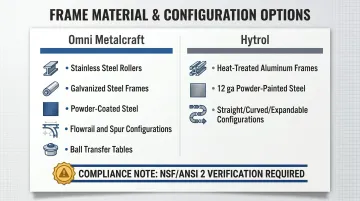
CRITICAL: Neither manufacturer holds confirmed NSF/ANSI 2 certification for gravity roller conveyors as of current verification. Food and beverage buyers must confirm certification status directly with each manufacturer before specifying.
Corrosion-resistant materials alone do not constitute FDA or NSF compliance without formal certification.
5. Parts Availability & Regional Support
Choose Omni if:
- You're a Midwest-based operation seeking Michigan-manufactured equipment with direct engineering access
- Custom configurations require close manufacturer collaboration
- Lead time predictability from US manufacturing matters more than distributor network breadth
Choose Hytrol if:
- You operate multi-site facilities requiring consistent parts availability across regions
- 150+ integration partners provide local technical support advantages
- Published case studies in your industry segment help validate specifications
Midwest Operations: Facilities in Wisconsin, Ohio, and surrounding states can consult John Maye Company, a 40+ year packaging and conveyor equipment distributor based in Waukesha, Wisconsin. Their manufacturer-trained team provides guidance on which system fits your specific load profiles, facility layout, and compliance requirements. With 2,500+ SKUs in inventory and a 24-hour ship guarantee, they offer parts availability advantages for both systems.
Conclusion
Neither Omni Metalcraft nor Hytrol is universally superior. Each manufacturer leads in distinct application areas:
- Omni Metalcraft: Heavy-load capacity, wide-bed versatility, and specialty configurations for automotive and heavy industrial environments
- Hytrol: Distributor network depth, proven fulfillment-grade deployments, and fast standardized spec turnaround for distribution and e-commerce
The right choice depends on what your facility's load profile, layout constraints, and compliance requirements demand. Selecting the wrong conveyor spec leads to roller deflection, premature wear, production slowdowns, and unplanned maintenance costs.
When conveyor downtime costs reach $10,000 to $260,000 per hour, the 20 minutes spent matching specifications to operational reality is the decision that prevents six-figure losses.
Frequently Asked Questions
What are the three types of conveyors?
The Material Handling Institute classifies conveyors into three primary categories: gravity conveyors (roller and skatewheel), powered conveyors (belt, chain, live roller), and specialized conveyors (vertical reciprocating, tow systems). Both Omni Metalcraft and Hytrol manufacture across gravity and powered categories.
How do belt conveyors differ from roller and drag chain conveyors?
Belt conveyors use a continuous moving surface ideal for small or irregular items; roller conveyors move products across rotating cylinders suited for flat-bottomed loads; drag chain conveyors pull heavy pallets using chains. Each type fits different load geometries and facility layouts.
Which manufacturer is better for food and beverage applications, Omni Metalcraft or Hytrol?
Both offer food-environment configurations—Omni with stainless steel rollers, Hytrol with aluminum frames for corrosion resistance. Neither holds confirmed NSF/ANSI 2 certification for gravity rollers, so request written documentation and verify sanitary design standards against your specific washdown requirements before purchasing.
What load capacity can Omni Metalcraft gravity rollers handle?
Omni's 1.9" rollers are rated at 269 lbs/roller; 2.5" rollers handle 645 lbs/roller. Always confirm the minimum number of rollers supporting the load at any given point—per-roller ratings don't equal total system capacity without accounting for load distribution.
Are Hytrol conveyors easier to source parts for than Omni Metalcraft?
Hytrol's 150+ North American integration partners give it a broader regional parts network, while Omni's Michigan manufacturing keeps sourcing accessible for Midwest buyers. Regional distributor proximity is the decisive variable—working with an established distributor like John Maye Company provides reliable access to parts from both manufacturers.
Can Omni Metalcraft or Hytrol gravity conveyors integrate with powered conveyor systems?
Yes—both manufacturers' gravity sections routinely combine with powered belt, MDR, or chain-driven sections in hybrid systems. Gravity sections typically serve as accumulation, staging, or discharge zones to reduce energy consumption between powered segments.