Introduction
Cold storage facilities operate in conditions that push standard packaging equipment to its breaking point. When a pallet wrapper fails at -10°F in a frozen food distribution center, production halts, load integrity is compromised, and temperature-sensitive products face exposure that can mean significant financial loss.
Not all pallet wrappers function reliably in sub-zero or near-freezing environments. Selecting a cold-rated wrapper is a different decision from choosing standard warehouse equipment — one that requires understanding cold-specific engineering, film performance, and drive system durability. This guide covers the key specs, machine types, and features that matter most for refrigerated and freezer operations.
Key Takeaways
- Pallet wrappers for cold storage need heated control enclosures, cold-rated lubricants, moisture seals, and low-temperature-rated electronics
- Top cold storage models include Lantech Q-300XT Plus, Robopac Stainless Steel Rotoplat 708, Orion Flex HPA, Phoenix PLP-2150, and ARPAC Pro-Series
- Selection depends on throughput volume, load stability requirements, floor space, and temperature depth
- Use cold-resistant stretch film with high inner cling — standard film fails in freezer environments
- Work with a distributor that offers manufacturer-trained technicians and cold-specific configuration support — not all distributors stock or service cold-rated equipment
What Makes Cold Storage Environments Challenging for Pallet Wrappers
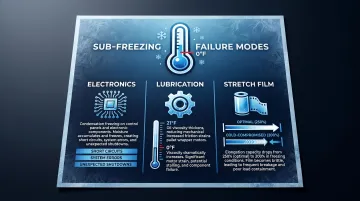
Sub-freezing temperatures cause standard pallet wrappers to fail at multiple critical points:
- Electronics: Condensation inside control panels freezes, causing board malfunctions
- Lubrication: Gearbox oils thicken to the point of failure — ISO VG 68 mineral oil becomes unusable below 21°F, while ISO VG 32 extends operation only to 0°F
- Stretch film: Brittle film loses elasticity and cling, with elongation capacity dropping from 250% at room temperature to around 200% in cold environments
The physical working environment compounds these mechanical issues. Workers wearing heavy cold-weather gear have limited dexterity, making manual wrapper operations more difficult and error-prone. Humidity fluctuations cause moisture ingress into machine components, where it freezes and causes breakdowns. Shortened operator tolerance for prolonged cold exposure increases the operational value of automation.
These operational pressures are intensifying as the industry scales. The U.S. cold storage market reached $46.3 billion in 2025 with a projected CAGR of 17.42% through 2034, driven by frozen food processing, dairy, meat and seafood, pharmaceutical cold chain, and cold beverage distribution. As throughput demands rise across these sectors, facilities face mounting pressure to deploy packaging equipment built specifically for temperature extremes.
Key Features of Cold-Rated Pallet Wrappers
Heated Control Panels and Electrical Enclosures
Cold-rated wrappers include internally heated cabinets that keep PLCs, touchscreens, and control boards operating within functional temperature ranges. Without heating, electronic components fail or behave erratically below 32°F, causing wrap cycle errors and machine downtime.
NEMA Type 12 enclosures protect against dripping water, dust, and fibers — the baseline for dry cold storage. Facilities with washdown protocols or heavy condensation should specify NEMA Type 4X, which adds protection against:
- Hose-directed water and ice formation
- Corrosion from moisture and cleaning agents
- Condensation buildup in freeze-thaw cycles
Cold-Temperature Gearbox Lubricants
Standard gear lubricants thicken at low temperatures, increasing mechanical wear and reducing turntable or rotary arm speed consistency. Cold packages substitute low-viscosity, temperature-stable synthetic lubricants designed to flow properly in freezing conditions, across both turntable drives and carriage mast systems.
Moisture and Condensation Management
Pneumatic air dryers and sealed enclosures prevent moisture from entering control systems and mechanical components, where it can freeze and cause breakdowns. The risk is highest in operations where wrappers move between ambient and refrigerated zones, where repeated temperature shifts produce condensation on internal components.
Cold-Rated Film Carriage and Pre-Stretch System
The powered pre-stretch carriage must remain functional in cold environments where standard rubber components on rollers can harden and crack. Cold-rated carriages use materials and tolerances designed for low temperatures, maintaining consistent pre-stretch performance (typically 200–260%) to reduce film consumption even in freezing conditions.
Automation Level and Load Stability Considerations
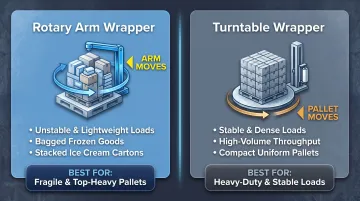
Rotary arm wrappers — where the load stays stationary and the arm orbits the pallet — are often preferred for unstable or lightweight loads like bagged frozen goods or stacked ice cream cartons. A rotating turntable can destabilize loosely packed cold-store loads, making the stationary-pallet approach more reliable for these products.
Fully automated inline wrappers also reduce how long workers spend in freezing zones. Less exposure in sub-zero areas improves both safety compliance and overall productivity.
Best Pallet Wrappers for Cold Storage Warehouses
The wrappers below were selected based on verified cold-temperature configurations, build quality suited to demanding environments, U.S.-based service infrastructure, and suitability for cold chain warehousing volumes and load types.
Lantech Q-300XT Plus (with Cold Temperature Package)
Lantech, headquartered in Louisville, KY, invented the stretch wrapper and maintains a strong track record supplying food, beverage, and warehouse operations. The Q-300XT Plus is their top-tier semi-automatic turntable model, available with a Cold Temperature Package engineered for refrigerated and freezer environments.
The Cold Temperature Package includes heated control enclosures and cold-rated lubricants across all drive systems. Moisture management components round out the cold-environment build. Lantech publishes a verified operating range of +20°F to +31°F (-7°C to -1°C) for the Q-300XT Plus cold configuration. The Load Guardian interface and automatic film cut-and-clamp reduce operator interaction time in cold zones.
| Feature | Specification |
|---|---|
| Cold Package Availability | Yes — rated +20°F to +31°F (-7°C to -1°C) |
| Key Cold-Rated Features | Heated control panel, cold-lube gearboxes, sealed enclosures, optional NEMA 12 enclosure; 200% standard pre-stretch |
| Load Capacity | 4,000 lbs |
| Wrap Height | 80 inches standard, 110-inch extended option |
| Best For | Medium to high-volume refrigerated warehouses and frozen food distribution needing semi-automatic wrapping with minimal downtime |
Robopac Stainless Steel Rotoplat 708 (Cold-Rated Configuration)
Robopac USA distributes the Rotoplat line of semi-automatic turntable wrappers, known for Cube Technology film optimization and R-Connect remote diagnostics. The Stainless Steel Rotoplat 708 is explicitly engineered for wet, cold, or washdown environments using solid stainless steel construction — not a coated alternative.
This dedicated cold/wet variant features protected electrical enclosures and delivers adjustable pre-stretch from 150% to 400% via dual independent motors. The R-Connect remote diagnostics capability allows maintenance teams to monitor machine performance from a warm room rather than entering the freezer zone — a practical benefit for facilities running continuous cold operations.
| Feature | Specification |
|---|---|
| Cold Package Availability | Yes — stainless steel construction for wet/cold environments |
| Key Cold-Rated Features | 100% stainless steel construction, cold-environment electrical protection, 150-400% variable pre-stretch, R-Connect remote diagnostics |
| Load Capacity | 4,400 lbs standard (5,500 lbs with additional casters) |
| Turntable | 65-inch heavy-duty, 28 heavy-duty casters |
| Best For | Cold storage facilities requiring consistent wrap data, remote diagnostics, and high wrap-cycle repeatability in wet or freezer conditions |
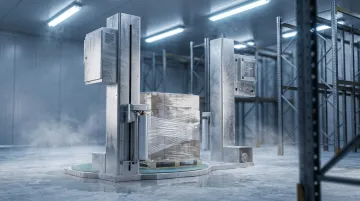
Orion Flex HPA (Cold-Rated Build)
Orion Packaging Systems, based in Alexandria, MN, manufactures rugged semi-automatic wrappers built for industrial environments. The Flex HPA model features heavy-duty steel frame construction and power pre-stretch up to 260%, giving it strong film economy on heavy frozen food pallets where over-stretch failures are costly.
The machine's steel construction and robust mechanical design make it less susceptible to cold-related wear than lighter-duty competitors. Automatic photo-eye height detection reduces operator interaction per wrap cycle, minimizing worker exposure to freezing temperatures.
| Feature | Specification |
|---|---|
| Cold Package Availability | Available (verify specific configuration with Orion) |
| Key Cold-Rated Features | Rugged steel construction, 260% power pre-stretch, automatic height detection; cold package for electronics and lubrication |
| Load Capacity | 5,000 lbs standard (6,000 lbs with 1 HP upgrade) |
| Turntable | 48 x 48 inches octagonal, 15 RPM variable speed |
| Best For | Industrial cold storage and frozen food warehouses where durability and film efficiency are primary priorities |
Phoenix PLP-2150 (Harsh Environment Design)
Phoenix Wrappers (Naperville, IL) builds the PLP series with emphasis on modularity and durability in harsh warehouse environments. The PLP-2150's no-lube chain drive and PLC controls reduce maintenance requirements — cold environments where accessing lubrication points means stopping production and re-entering freezing zones.
The modular design allows configuration and upgrades for cold environments. The no-lube chain drive eliminates one of the most common cold-environment failure points (lubricant thickening in chain systems), making it a strong candidate for refrigerated warehouses prioritizing long service intervals.
| Feature | Specification |
|---|---|
| Cold Package Availability | Verify cold-environment configuration options with Phoenix |
| Key Cold-Rated Features | No-lube chain drive, PLC controls, modular upgradeable design; 245% power pre-stretch |
| Load Capacity | 5,000 lbs |
| Turntable | 56 x 56 inches, 15 RPM (fastest in class) |
| Best For | Refrigerated warehouses prioritizing low-maintenance operation and long service life in harsh conditions |
ARPAC Pro-Series (Automated Cold Chain Integration)
ARPAC (Schiller Park, IL) manufactures the Pro-Series automatic stretch wrappers designed for high-throughput conveyorized packaging lines. These systems handle 25–40 loads per hour according to distributor specifications with automatic film apply and cut, making them relevant for large-scale cold storage distribution facilities where minimizing manual labor in freezing zones is critical.
For high-volume cold chain operations such as frozen food distribution centers or large dairy logistics hubs, full automation reduces worker exposure to freezing zones while maintaining consistent wrap quality at high throughput.
| Feature | Specification |
|---|---|
| Cold Package Availability | Verify cold-environment configuration with ARPAC |
| Key Cold-Rated Features | Full inline automation, 25-40 loads/hour, 150-300% pre-stretch; cold packs and freezer packs available |
| Load Capacity | 4,000 lbs |
| Drive System | ANSI 50 chain drive (no rubber belts) |
| Best For | Large-scale cold storage distribution centers needing fully automated wrapping with minimal operator presence in freezing zones |
How We Chose the Best Cold Storage Pallet Wrappers
Machines were evaluated specifically on whether they offer verifiable cold temperature packages — heated enclosures, cold-rated lubricants, and moisture management systems. Build quality for low-temperature environments, U.S.-based service and parts support, and suitability for cold chain warehousing volumes and load types were all critical selection criteria.
A common mistake buyers make is selecting a standard wrapper and assuming it will perform in cold environments. Cold-specific engineering is the baseline requirement — not an upgrade. Standard wrappers operating below their rated temperature range experience accelerated component failure, inconsistent wrap cycles, and shortened equipment lifespan.
Getting the selection right means evaluating the entire system, not just the machine. Three factors drive cold storage wrapper performance:
- Machine cold package — heated enclosures, cold-rated lubricants, and moisture sealing
- Stretch film specification — cold-resistant films with higher inner cling are required, not optional
- Maintenance frequency — standard service intervals are insufficient in freezing environments where seal degradation, lubrication breakdown, and electrical connection stress all accelerate
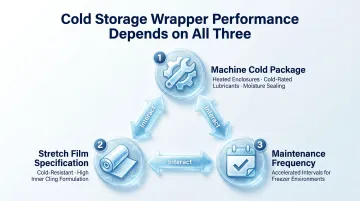
These variables interact — a well-specified machine paired with the wrong film or skipped maintenance will still underperform. Working with a manufacturer-trained distributor like John Maye Company helps facilities match the right cold-rated wrapper to their specific temperature range, throughput, and load profile before committing to purchase or rental. The company has served Midwest food, pharmaceutical, and warehousing operations for over 40 years.
Conclusion
Getting pallet wrapping right in a cold storage environment comes down to three non-negotiables: verified cold-rated equipment, film formulated for sub-freezing conditions, and service support from technicians who know freezer-zone machinery.
Before committing to a machine, evaluate beyond the spec sheet:
- Cold package documentation — confirm the manufacturer formally rates the unit for your target temperature range
- Parts availability — cold-environment components (motors, film carriages, controls) must be stocked locally or ship within 24 hours
- Regional service capability — verify your distributor has factory-certified technicians who service freezer-zone equipment, not just ambient warehouse machines
John Maye Company has been supporting Midwest cold storage and food & beverage operations since 1983, with factory-certified technicians and 2,500+ SKUs in inventory. Contact their team to identify a cold-rated pallet wrapper matched to your facility's temperature zone and throughput requirements.
Frequently Asked Questions
Frequently Asked Questions
What is a "cold temperature package" on a pallet wrapper?
A cold temperature package is a manufacturer-specified set of component upgrades — typically including heated electrical enclosures, cold-rated gearbox lubricants, and condensation management systems — that allow the machine to operate reliably in refrigerated or freezer environments down to a specified minimum temperature.
What temperature range can cold-rated pallet wrappers typically operate in?
Most cold-rated stretch wrappers handle refrigerated environments (32–40°F) down to approximately -22°F for freezer use, though specs vary by model. For example, the Lantech Q-300XT Plus is rated for +20°F to +31°F. Always confirm the exact operating range with the manufacturer before purchasing.
What type of stretch film should be used with pallet wrappers in cold storage?
Use cold-resistant stretch film formulated with high inner cling and cold-flexible polyethylene. Standard film becomes brittle below 32°F, losing cling and increasing breakage risk — and film elongation capacity drops roughly 20% in cold environments. Specialized formulations compensate for both issues.
Are rotary arm wrappers better than turntable wrappers for cold storage?
Rotary arm wrappers are often preferred for unstable or lightweight loads in cold storage (since the pallet stays stationary), while turntable wrappers work well for stable, dense loads. The best choice depends on load type, not temperature alone — both can be configured with cold temperature packages.
Can an existing pallet wrapper be retrofitted for use in a cold storage environment?
Retrofitting is possible in some cases — adding heated enclosures, swapping lubricants, and installing pneumatic dryers are common modifications. Feasibility depends on the machine's age and model, so have a manufacturer-trained technician evaluate it before attempting any conversion.
How often should pallet wrappers in cold storage be serviced compared to standard environments?
Cold environments accelerate wear on seals, lubrication systems, and electrical connections, so preventive maintenance intervals run more frequently than in standard warehouses. Follow the manufacturer's cold package documentation, paying close attention to heated enclosure performance and moisture control.